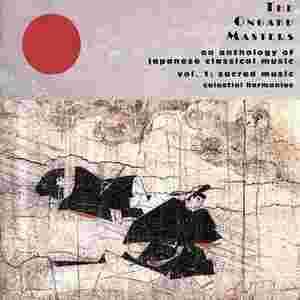
presented in a black linen box, spans 1,000 years of Japanese classical/traditional music,
from early Buddhist Shomyo chant to late 20th century Takemitsu. It touches on every
relevant stage in the development of Japanese music from the distant origins on the Asian
mainland to contemporary s. Leading scholars from universities on three continents
contributed to extensive and informative booklet notes which also contain images from several
leading Japanese museums. Close to 100 musicians are singing and playing on these recordings.
The musical material presented in this collection has been drawn from the Celestial Harmonies
catalogue and spans two decades of work. When approaching the music of a cultural bloc, there
is an understandable tendency to treat the traditions of that bloc as a unified entity: one speaks of
Western music, Indian music, Chinese music, African music, and so on. Of necessity, such a
monolithic viewpoint is a vast oversimplification, ignoring the differentiations, for example, between
Western Baroque, Classical, Romantic, and other musical genres, or between Indian Hindustani
and Karnatic musics, or in the present case, between the large variety of differing genres that are
together referred to as hogaku, literally "music of the homeland (Japan)", or Japanese traditional
music. There are a number of intersecting ways of catagorising hogaku. One is to view the various
styles according to their social role. Another possibilty is to distinguish genres where music is
presented in a context with other art forms—theatre or dance—from genres in which instrumental
and vocal performance are the sole presentation. This collection concentrates on the various
streams of Japanese instrumental and vocal music leaving the theatrical forms of No, Kabuki,