|
Agencja Wydawnicza ,,Promocja'' 39-300 Mielec, ul. Jana III Sobieskiego 1
Zaprasza do zakupów naszych przedmiotów wystawianych na allegro oraz z z i innych oferowanych przez nas usług,
m.in. w zakresie wszelkiego rodzaju druków i wydawnictw, promocji i reklamy oraz archiwizacji i porządkowania zbiorów.
Przed zakupem prosimy o zapoznanie się z warunkami naszych aukcji na stronie o mnie - zakup oznacza ich akceptację!
Zapraszamy do zaznajomienia się z naszą pozostałą ofertą na stronie nasze inne aukcje - więcej zakupów to niższe koszty wysyłki!
Nasz kontakt: [zasłonięte]@interia.pl tel./fax 17 [zasłonięte]1498 tel. kom.: 602 [zasłonięte]362 lub 0602 [zasłonięte]197
Zapraszamy do skorzystania z naszej oferty i życzymy zadowolenia z jej realizacji!
|
|
Przedmiotem naszej aukcji jest:
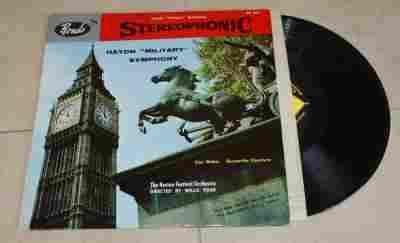
HAYDN "MILITARY" SYMPHONY
Stereophonic ST 501, USA
średnica płyty 30 cm stan db+/bdb- minimalne ryski, oprawa stan db+ drobne przetarcia
Polecam i zapraszam do licytacji
A/18293
HAYDN "MILITARY" SYMPHONY
The Boston Festival Symphony — Directed by Willis Page
Haydn had a knack for writing symphonies which would acquire nicknames. Affectionate labels such as "Surprise," "Clock," "Farewell," "Toy," "Drum-Roll," "Military," make up a list which rivals the output of many a more flamboyant composer. The title of the "Military" symphony refers to Haydn's original use of percussion instruments rather than to a specific "program." It is Symphony No. 100 in G Major.
The "Military" Symphony was one of the second group of six for which we have to thank the English. The manuscript was dated 1794 and the first performance was given at Londomin the Hanover Square Rooms on May second of that year. The concerts were sold out, and Haydn's success, already established, approached new heights. The gentry, the nobility, and even royalty emulated one another in doing him homage, and he was personally invited by the queen to make England his permanent home. London was at his feet, eulogies were written for him, and Oxford University conferred the degree of Doctor of Music upon him.
The second series of London symphonies were even more enthusiastically received than the first, and of these particular attention was bestowed upon the "Military." It seems a very modest little
symphony to our ears, accustomed as they are to the mountainous sonorities and endless colors of the modern orchestra. Once having heard "battle music" and similar descriptive efforts of romantic and modern composers, Haydn's symphony, one concludes, must have been dealing with toy soldiers. It gets its title probably from the second movement, an allegretto in which trumpets and percussion instruments are used rather more conspicuously and more extensively than was customary in eighteenth-century music. There is no occasion for pointing out further detail, and no conspicuous feature to distinguish this from other Haydn symphonies except those just noted. Like all his work in this form, Haydn's "Military" Symphony is notable —not particularly among its fellows, but among the works of other composers—for the grace and symmetry of its form, the geniality and melodious attractiveness of its content, and its peerless craftsmanship. As one biographer and musical commentator remarks of the London symphonies, including the "Military," they were "suffused with the sense of mellowness and maturity, of long experience and an old age honorably won; too serene for passion, too wise for sadness, too single-hearted for regret, (they) have learned the lesson of life and will question its fate no further."
|