Ta strona wykorzystuje pliki cookies. Korzystając ze strony, zgadzasz się na ich użycie. OK Polityka Prywatności Zaakceptuj i zamknij X

GREEN METROPOLIS

10-04-2015, 6:26
Aukcja w czasie sprawdzania nie była zakończona.
Cena kup teraz: 105 zł     
Użytkownik bookstreet
numer aukcji: 5166607754
Miejscowość Kalisz
Zostało sztuk: 10    Wyświetleń: 3   
Koniec: 10-04-2015, 6:28

Dodatkowe informacje:
Stan: Nowy
Okładka: miękka
Kondycja: bez śladów używania

info Niektóre dane mogą być zasłonięte. Żeby je odsłonić przepisz token po prawej stronie. captcha

978[zasłonięte][zasłonięte]86402, 978[zasłonięte][zasłonięte]44848, 978[zasłonięte][zasłonięte]12058, 978[zasłonięte][zasłonięte]34557, 978[zasłonięte][zasłonięte]30044, 978-[zasłonięte][zasłonięte]86402, 978-[zasłonięte][zasłonięte]44848, 978-[zasłonięte][zasłonięte]12058, 978-[zasłonięte][zasłonięte]34557, 978-[zasłonięte][zasłonięte]30044
TEL: 607-[zasłonięte]-671
GG: [zasłonięte]16851
EMAIL: [zasłonięte]@bookstreet.pl

Kupując kilka książek za wysyłkę płacisz tylko raz! 

Do realizacji zamówienia przystępujemy po otrzymaniu zapłaty za towar lub wybraniu opcji przesyłki za pobraniem. Książki wysyłamy w ciągu 5-7 dni roboczych, nie ma możliwości szybszej realizacji.
Wystawiamy faktury VAT.

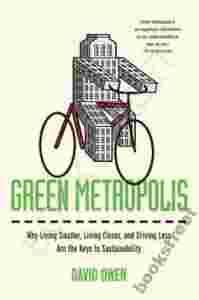
Green Metropolis: Why Living Smaller, Living Closer, and Driving Less Are the Keys to Sustainability

PRODUCT DETAILS:
Author: David Owen (US)
Language: English
Publisher: Penguin
Publication Date: 25 Aug 2011
Dimensions: 15.3 x 2.6 x 20.9 cm
Format: Paperback
Pages: 368
Condition: NEW
Product_ID: 15944D4848

In this remarkable challenge to conventional thinking about the environment, David Owen argues that the greenest community in the United States is not Portland, Oregon, or Snowmass, Colorado, but New York, New York. Most Americans think of crowded cities as ecological nightmares, as wastelands of concrete and garbage and diesel fumes and traffic jams. Yet residents of compact urban centers, Owen shows, individually consume less oil, electricity, and water than other Americans. They live in smaller spaces, discard less trash, and, most important of all, spend far less time in automobiles. Residents of Manhattan- the most densely populated place in North America -rank first in public-transit use and last in percapita greenhouse-gas production, and they consume gasoline at a rate that the country as a whole hasn't matched since the mid-1920s, when the most widely owned car in the United States was the Ford Model T. They are also among the only people in the United States for whom walking is still an important means of daily transportation. These achievements are not accidents.Spreading people thinly across the countryside may make them feel green, but it doesn't reduce the damage they do to the environment. In fact, it increases the damage, while also making the problems they cause harder to see and to address. Owen contends that the environmental problem we face, at the current stage of our assault on the world's nonrenewable resources, is not how to make teeming cities more like the pristine countryside. The problem is how to make other settled places more like Manhattan, whose residents presently come closer than any other Americans to meeting environmental goals that all of us, eventually, will have to come to terms with.

Książki wysyłamy w ciągu 5-7 dni roboczych.


THE BURNING QUESTION Berners-Lee, Clark

CREATING SUSTAINABLE CITIES Herbert Girardet

THE CITY SHAPED Spiro Kostof, Richard Tobias

GROUND CONTROL Anna Minton

THE IMAGE OF THE CITY Kevin Lynch

TRIUMPH OF THE CITY Edward Glaeser