|
INNOVATIVE...EXCITING...PRACTICAL!
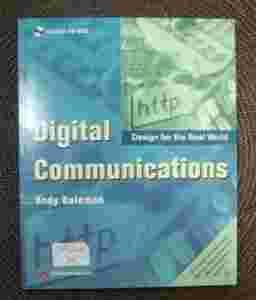
Digital Communications: Design for the Real World introduces readers to the fundamentals of digital communications through an applications-driven approach.
Devised specifically to serve as a first stage text for undergraduate students, this textbook + CD package relates theory to real-world products and emphasizes the design choices facing professional communications engineers, thereby bringing this exciting subject vividly to life. Students encountering communications topics for the first time, practising engineers and managers will all appreciate the stimulating and motivational treatment of the subject.
Andy Bateman's innovative solution to the teaching and study of digital communications presents the reader with 3 routes to success...
1: USING THE BOOK
The text focuses on digital transmission and modem design, identifying performance trade-offs, design choices and practical issues in implementation over real-world channels. It covers the very basics for true beginners, as well as modern developments such as channel coding and CDMA. By emphasizing the design choices facing communications engineers, the book will also be suitable for practising engineers and managers allowing them to home in on the design parameters that are pertinent to their particular application and specification.
FEATURES:
-
applications-driven approach highlights the key design issues
-
basic topics such as Fourier series and relevant trigonometrical relationships are reviewed in the opening chapter
-
in depth sections provide analytical backup to the design-oriented text
-
modern, real-world examples are used throughout to enhance understanding
-
end-of-chapter questions can be used for self-assessment
2: USING THE CD-ROM
The book comes complete with a CD-ROM which contains the same content of the book in browsable electronic form, suitable for Mac, Windows and UNIX systems.
Lecturers may be attracted by the electronic version as it is provides an easy way to generate transparencies for their lectures. Departments may want to network the electronic version to encourage students to access the material. Students prefer
electronic access for revision purposes and professionals for quick referencing.
The electronic files are bundled with a free copy of Internet Explorer. They will be available for Windows (3.1. and above), Mac and UNIX systems. All purchasers of the book will also be able to access any updates (including textual corrections, additional chapters, additional worked examples, case-studies, Matlab code and problems) free of charge from our website. Details will be provided in the book.
FEATURES:
-
navigable files for viewing with Microsoft Internet Explorer 4
-
animated figures to aid understanding
-
internal hyperlinks for ease of navigation
-
external hyperlinks to further information
-
Matlabr code, ready to run simulations
-
answers to problems from the printed text
3: USING THE BOOK + CD-ROM IN PARALLEL
The two components of the package are completely interchangeable, providing the most flexible solution to the teaching and study of digital communications.
-
easy-to-read text in book
-
access to Matlab code on CD-ROM
-
WWW references in book; external hyperlinks from CD-ROM
-
diagrams in book brought to life through animations on CD-ROM
Who Needs This Book?
-
students encountering communications topics for the first time, specifically 1st and 2nd year undergraduates studying data transmission within Electronic Engineering degree programmes
-
practising engineers and managers
What makes Bateman stand out from the crowd?
In other competing student texts the subject matter is predominantly driven from a mathematical description of modulation type and performance, rather than the application and intuitive approach of this text. In addition, other textbooks rarely
present the design choices and trade-offs made in communications design. They simply present the facts and rely on the reader to become aware of the trends and compromises that exist in practice.
The subject material in this book is a focused subset of many other digital communications texts - omitting topics such as probability theory, sampling theory and waveform encoding, and instead choosing to elaborate on modem design, identifying performance trade-offs, design choices and practical implementation issues over real world channels. Rather than attempt to cover each topic in minute detail, the approach taken is to provide the framework in which the reader can identify those design aspects relevant to his or her application and then use more in-depth publications to obtain more specific information
Preface
How to use the combined book and CD
1 Background material
1.1 Time/frequency representation of digital signals
1.2 Trigonometric relationships
1.3 Communications networks and signalling protocols
1.4 Definition of terms
2 Data transmission fundamentals
2.1 Factors affecting system design
2.2 Data transmission fundamentals
2.3 Multi-level signalling (M-ary signalling)
2.4 Calculation of channel capacity
3 Baseband data transmission
3.1 Introduction
3.2 Intersymbol interference (ISI)
3.3 Eye diagrams
3.4 Raised cosine filtering
3.5 Matched filtering
3.6 Partial response signalling
4 Sources and examples of channel degradation
4.1 Introduction
4.2 Gain, phase and group delay distortion
4.3 Interference and noise
4.4 The telephone channel
4.5 The wireless channel
5 Bandpass digital modulation
5.1 Introduction
5.2 Amplitude shift keying (ASK)
5.3 Frequency shift keying (FSK)
5.4 Phase shift keying (PSK)
5.5 Comparison of binary modulation schemes
6 Multi-level digital modulation
6.1 Introduction
6.2 M-ary amplitude shift keying (M-ary ASK)
6.3 M-ary frequency shift keying (M-ary FSK)
6.4 M-ary phase shift keying (M-ary PSK)
6.5 Combined amplitude and phase keying
6.6 Relative performance of multi-level bandpass modulation formats
7 Coding theory and practice
7.1 Source coding
7.2 Channel coding
7.3 Block coding
7.4 Advanced block coding
7.5 Convolutional coding
7.6 Combined coding and modulation
8 Multi-user digital modulation techniques
8.1 Introduction
8.2 Frequency division multiple access (FDMA)
8.3 Time division multiple access (TDMA)
8.4 Code division multiple access (CDMA)
8.5 Combined multiple access systems
Glossary
References
Index
Andy Bateman is a leading authority in this field. Until recently he was Professor of Signal Processing at the University of Bristol and is he now a Director of Wireless Systems International Ltd. The book is based on his undergraduate teaching at Bristol and his training courses for professionals. He has extensive practical experience in the `real-world' having performed consultancies with organisations such as the Canadian Department of Communications, Renishaw UK, British Telecom, Australia Telecom, Hewlett-Packard, Philips, Plessey Avionics, Bell Operating Com
|