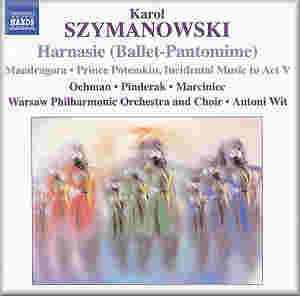
Zapraszam na inne moje aukcje. Warto, ponieważ koszt przesyłki jest stały, niezależnie od ilości wylicytowanych płyt.
Wydawca : NAXOS 8.570723 Rok wydania : 2009
Playing time : 73:17
KAROL SZYMANOWSKI
1-11. Harnasie Ballet-Pantomime , Op. 55 (1923-31) [35:47] 12-14. Mandragora Pantomime , Op. 43 (1920) [27:04] 15. Kniaź Patiomkin / Prince Potemkin , Op. 51 (1925) [10:26]
ORKIESTRA SYMFONICZNA I CHÓR FILHARMONII NARODOWEJ / Warsaw Philharmonic Orchestra 1-3 and Choir Antoni WIT - dyrygent Wiesław OCHMAN - tenor Alexander PINDERAK - tenor Ewa MARCINIEC - mezzosopran Henryk WOJNAROWSKI - kierownik chóru
Here’s a set of rare works indeed by a composer who is no longer a bit of an interloper in the recording world. He is coming to be regarded as one of the 20th Century greatest masters. And how good to have this music played by an orchestra under a conductor who have such a down-to-earth understanding of 20th Century Polish Music and of Szymanowski in particular. They have also recorded the complete output of Lutosławski. Let’s start with the big work ‘Harnasie’. Perhaps, like me you are coming to it for the first time. Composed in the composer’s third period - the time when he was most interested in the folk music of Poland - this ballet tells a story vaguely reminiscent of Peer Gynt. A bride is abducted on her wedding day, not by an individual lover but by a tribe of Tatra Highlanders - the Harnasie. This allows Szymanowski a chance to indulge his love of the dances and melodies of the Tatra Mountains and to pour his ideas into this ballet score. He rented a house for many years in the region and often heard and noted the music he found around him. The final result is a red-blooded, joyous and at time frenetic and heady mixture of Bartók, Borodin and Ravel (of La Valse?). Its thirty-five minutes flash by. There are marches, drinking songs and all sorts of dances and goings-on. There are therefore certain sung sections - Szymanowski himself and Jerzy Rytard wrote the text - which come off very well from a very authentic sounding choir. Naxos have not, indeed apparently could not supply the texts due to copyright reasons. However Keith Anderson in his booklet notes does not even offer us a scene by scene résumé, although we have several performer biographies and photographs and an extended biographical essay on Szymanowski which is very handy. The volume control I have found must be set at a much higher level than usual to get the full benefit of the intoxicating orchestration. The opening flute solo needs to be quite loud and that will prevent you from constantly making adjustments. We often talk of Szymanowski’s influences as Scriabin, or Debussy or Polish folk dances and the ballet Mandragora demonstrates his magpie tendencies further. Written during a transitional phase in the composer’s career here we can find Stravinsky, even Borodin (again) and in part 2, I think Manuel de Falla. Stravinsky is also in the mix, especially Petrushka, a score Szymanowski much loved and lies behind the work’s commedia dell’arte story line. There is even a part for what seems to be an off-stage bel canto tenor or is he just distantly recorded. It is wonderfully performed by Alexander Pindarak who also has a few rather curious, spoken words in part 3. Like Petrushka it is at times so descriptive that cartoon music comes to mind. The whole piece is one scintillating musical parody. It is here wonderfully played with many, many details clearly articulated with Szymanowski’s unique language clearly understood by orchestra and conductor. Composed midway between these two masterpieces comes the unpublished, brief ‘Prince Potemkin’ incidental music. The play in question was by Szymanowski’s friend Tadeusz Miciński. He had worked with him before on for example the text of the 3rd Symphony and his exotic, oriental ideas had inspired King Roger the work immediately preceding this one. Potemkin inhabits a world of half-lights and mystery - slow and magical both in harmony and orchestration. It includes a mezzo-soprano and again, a chorus in its second half. Despite its impressionist atmosphere it also uses a Tatra folk-tune, here to quote Keith Anderson “transformed for an evocative dramatic purpose in music that has a valid existence apart from the play.” A-men to that. As well as the essay and photographs of the performers we have their career profiles which are given generous space. I find this to be an excellent disc both in repertoire and in performance and if it were full price I would hunt it out. As it is, it will fit neatly into a Saturday shopping trolley and give you hours of fascinating listening. Gary Higginson
Płyta CD oryginalna, nowa, zafoliowana.