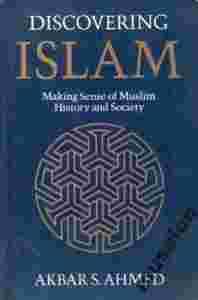
Akbar S. Ahmed
Discovering Islam. Making Sense of Muslim History and Society
Routledge 1988
Stron X+251
Książka używana w stanie bardzo dobrym - minimalne zagięcia okładki
Writing in the tradition of the great Arab historian Ibn Khaldun, Akbar S. Ahmed provides an explanation of Muslim history and society of interest to Muslims and non-Muslims alike. Islam is popularly seen, especially in the West, as aggressive and fanatic. This readable and accessible account, by an internationally known social scientist, balances that image. Dr Ahmed skilfully combines an astute understanding of Islamic history with sociological analysis of contemporary Muslim societies. The book ranges widely, from the origins of Islam and the history of the great Muslim empires, through an account of sufis. saints, and scholars, to discussions of modern Islamic societies, including an account of the place of women in Islam. The objective picture which emerges brilliantly illuminates the main features of Muslim history and explains the compulsions of Muslim society. THE AUTHOR Akbar S. Ahmed is Commissioner of Sibi Division in Baluchistan Province. Pakistan. Educated at Punjab University, and the Universities of Birmingham. Cambridge, and London, he has been Visiting Professor at the Institute for Advanced Study, Princeton and Harvard University. He has also been on the faculty of the Islamic Institute of Advanced Study. USA: the Islamic Academy. Cambridge; the University of Washington: and the Quaid-e-Azam University. Islamabad and has been offered the Allama Iqbal Fellowship/Chair in Pakistan Studies at Cambridge University. Dr Ahmed has travelled extensively in the Muslim world and given lectures and seminars on Islam to audiences in the USA. the UK. the USSR. Japan. India. Egypt. Turkey. France, and Saudi Arabia. He is the author of Millennium and Charisma among Pathans (Routledge & Kegan Paul. 1976). Pukhtun Economy and Society (Routledge & Kegan Paul. 1980). Religion and Politics in Muslim Society (Cambridge University Press. 1983). Pakistan Society: Islam. Ethnicity and Leadership in South Asia (Oxford Univer¬sity Press. 1986) and co-editor (with D. Hart) of Islam in Tribal Societies (Routledge & Kegan Paul. 1984). Contents Preface ix 1 Introduction: discovering Islam 1 Part One The Pattern of Islamic History 2 Muslim ideal: holy Book and Prophet 15 3 A theory of Islamic history 30 1 Ideal caliphs 33 2 Arab dynasties: Umayyads and Abbasids 38 3 The flowering of Islamic civilization 44 4 Decline and fall 51 5 Shias: revolution in the revolution 55 6 Mahdism and millenarian movements 61 4 The great Muslim empires: Ottomans, Saffavids and Mughals 65 1 Ottomans: facing Europe 65 2 Saffavids: Shia state 69 3 Mughals: encounter with Hinduism 72 4 Obsession and synthesis 86 5 Sufis and scholars 90 1 Sufis, saints and mystics 91 2 Two scholars of Islam: Al Beruni and Ibn Khaldun 98 6 Islam of the periphery 107 1 On the periphery 107 2 The Muslim minority in China 110 3 Muslims in the USSR 111 7 Under European rule: the colonial impact on Muslim society 117 1 The disintegration of society 118 2 The myth of the noble savage: Muslim tribesman 132 Part Two Contemporary Muslim Society 8 Princes and paupers: Muslim societies in Saudi Arabia and south India 143 1 Saudi Arabia: the reawakening of the peninsula 144 2 The Andalus syndrome in south India: a la recherche du temps perdu 158 9 Muslim society turned inside out: ethnicity, women and refugees 172 1 'Dubai chalo': ethnic encounters between Middle Eastern and South Asian Muslim societies 172 2 Muslim women 184 3 Afghan refugees: displacement and despair 196 10 The reconstruction of Muslim thought 200 1 Contemporary Muslim scholarship 200 2 Creating Islamic social sciences 208 11 Only connect 217 1 American society: Great Satan or paradise on earth? 217 2 Connecting 221 3 Conclusion: the discovery of Islam 227 Appendix: Muslim chronology 232 Glossary of Islamic terminology 237 Bibliography: suggested readings 238 Index 240